

Most organizations struggle to keep their operational applications, AI agents, and analytical platforms in sync. Transaction systems, dashboards, and ML models each see a different version of the truth, creating reconciliation work, brittle integrations, and slow iteration on new data products. There is also a substantial friction in making these unified systems scalable, robust and dynamic enough to handle rapidly shifting requirements and usage patterns of these data products.
Developer and business interfaces are too distant and siloed for it to be tangibly beneficial back to business users, which leads to even the best data lakehouses rendered not usable enough for real world business impact.
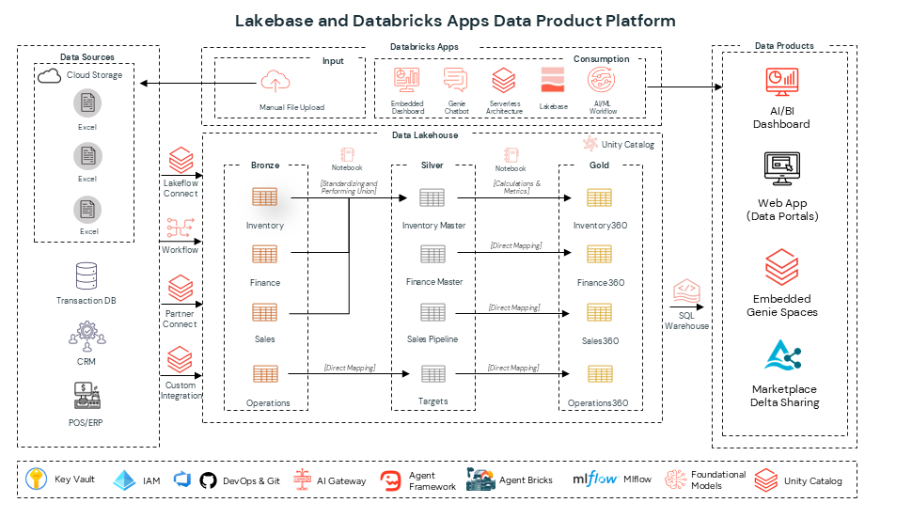
Here comes in zeb’s Rapid App Deploy accelerator leveraging Lakebase to rapidly build and deploy AI-Driven Data Products; This accelerator centers everything on Lakebase as the persistent, transactional data layer that serves both operational and analytical needs. Databricks Apps simply provides the native experience layer to host workflows, Genie spaces, and dashboards that sit directly on top of that unified data foundation with reverse ETL and ingestion from curated datasets in the data lakehouse. It brings agent-driven insight, automated entity unification, and centrally governed mastering into one streamlined framework that turns disconnected internal and third-party feeds into a dependable, continuously updated entity foundation without the usual reconciliation effort or model-building drag. Lakebase underpins the accelerator, enabling consistent, high-performance access and seamless integration across all entity workflows.
Unifying Operational and Analytical Worlds
Instead of maintaining separate OLTP databases and a lakehouse, zeb’s accelerator leverages Lakebase as serverless and persistent operational data store for normalized, transactionready Delta tables that can be read and written by both applications and analytics. The same tables support:
- High concurrency inserts/updates for app workloads
- Low latency lookups for AI agents and APIs
- Batch, streaming, and BI queries for analytics
This collapses the traditional divide between “systems of record” and “systems of insight” into one shared layer.
Marrying Developer and business interfaces
Technical developers work directly against Lakebase using familiar SQL, APIs, and workflows, while business users interact through Databricks Apps and embedded dashboards. The platform becomes a single surface where:
- Engineers define schemas, pipelines, and agent integrations
- Business users see governed apps, metrics, and conversational analytics backed by the same data
No separate app stack or bespoke backend is required; Databricks Apps is a conduit that exposes Lakebasebacked data products in a businessfriendly way.
Lakebase as persistent memory an storage interface for AI agents
Scaling AI agents in production requires durable, transactional memory not just a vector store or cache. We leverage Lakebase for its:
- Row-level ACID guarantees for agent state, events, and feedback. Instead of pushing everything into a single vector index, memory can be modelled as Delta/Lakebase tables.
- Fast point lookups and updates for per-user or per-entity context. Normalized entities (customers, assets, tickets, orders) plus “assertions” or summaries that agents can retrieve and update in real-time or near real-time.
- Shared tables for features, interactions, and outcomes that both agents and analytics can use. Because these live in Lakebase, agents can safely update state inline with user requests while analytics jobs read the same tables for monitoring and improvement.
- Because Lakebase is also governed by Unity Catalog, every action is stored as a structured event, giving full traceability for debugging, compliance, and safety reviews.
Agents read context and write outcomes into Lakebase, while serverless compute handles spikes in traffic without manual capacity planning.
Reverse ETL into Lakebase
Rather than pushing curated data only out to external SaaS products, reverse ETL pipelines load mastered entities, metrics, and features back into Lakebase. That means:
- Operational apps and agents always see the latest, governed definitions
- Changes in analytical logic (metrics, features, segment definitions) automatically flow into the transactional layer
- Downstream systems can integrate via simple SQL, APIs, or Delta Sharing against Lakebase tables
Lakebase becomes the activation point where analytical intelligence is made operational.
Business Interfacing with Databricks Apps
zeb leverages Databricks Apps as a part of the overall solution in an intentionally light-weight solution: we simply provide an interface that hosts the UI, orchestrates calls to Lakebase and model endpoints, and embeds Genie and dashboards:
- Zero-friction path from Lakebase tables to production-grade internal apps
- Consistent identity, security, and governance via Unity Catalog
- Tight integration with workflows, model serving, and AI Gateway
But the center of gravity is Lakebase: Apps surfaces Lakebasebacked data products in a form that business teams can actually use.
Repeatable and Maintaneable Business Data Products
By standardizing on Lakebase plus Databricks Apps, organizations can:
- Launch new AI-infused data products faster, without rearchitecting per use case
- Reduce integration and reconciliation overhead between operational/transactional and analytical systems
- Give AI agents a robust, governed memory layer that improves with every interaction
- Offer a single, governed platform where developers, analysts, and business users collaborate on the same data
This isn’t just a design pattern; it’s a blueprint for any enterprise that wants operational applications, analytics, and AI agents all working from one transactional, lakehousenative foundation.

 +1 732 737 9188
 sales@zeb.co