

MODE is a leading logistics service provider specializing in freight management, warehousing, and supply chain optimization. With a strong focus on technology, MODE integrates advanced logistics software to streamline operations and deliver superior customer service.
75%
Improved network visibility
60%
Faster incident response
45%
Stronger overall security posture

Industry
Digital Services
Service
AWS Security Enhancement & 24/7 SOC Enablement
Tech Stack
Amazon Cognito, AWS Security Hub, Amazon Macie, VPC Flow Logs, AWS Backup, AWS Shield Advanced, CI/CD Security Tools

Our client had implemented foundational security controls, but monitoring and governance remained fragmented. Authentication mechanisms were basic and lacked centralized scalability, increasing the risk of inconsistent access control and unauthorized access.
Security tools operated independently, without a unified dashboard to prioritize findings across AWS services. Visibility into sensitive data and anomalous access patterns was limited, and manual compliance tracking processes made it difficult to demonstrate regulatory adherence.
Network segmentation was insufficiently structured, leaving workloads exposed to potential lateral movement. Backup processes were manual, introducing recovery risks. Application security relied heavily on manual code reviews, leading to vulnerabilities being detected late in the development lifecycle. Additionally, increasing DDoS risks required stronger perimeter protection and continuous monitoring capabilities.
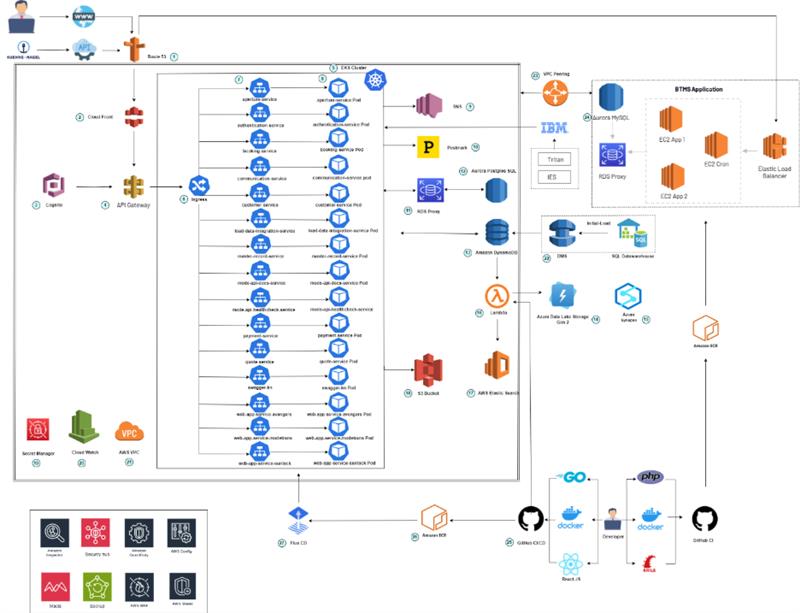
zeb implemented a structured security transformation program designed to enhance identity governance, centralize monitoring, strengthen network visibility, and enable continuous threat detection.
To strengthen authentication and access control, we implemented Amazon Cognito, providing secure, centralized, and scalable user authentication across applications.
Centralized root account governance controls were introduced across MODE’s AWS accounts to secure privileged access. Root credential monitoring was enabled to detect unauthorized activity, reducing risks associated with unmanaged account-level changes.
To eliminate fragmented monitoring:
This provided MODE with consolidated visibility into threats and data-related risks across their AWS environment.
Network architecture was redesigned using structured VPC segmentation with dedicated subnets for application tiers and sensitive workloads. Security policies were refined to restrict communication between segments, reducing lateral movement risks.
To enhance traffic monitoring and forensic readiness, VPC Flow Logs were enabled and integrated into the centralized monitoring environment, providing detailed insights into network traffic patterns and suspicious connection attempts.
Manual backup processes were replaced with AWS Backup, automating backup and recovery of critical workloads. This ensured consistent protection policies, reduced operational risk, and improved recovery reliability.
Static code analysis tools were integrated into MODE’s CI/CD pipeline, enabling automated vulnerability detection during development and reducing late-stage security findings.
A structured compliance mapping framework was developed to align AWS security controls with applicable regulatory requirements, simplifying audit readiness and improving governance transparency.
To mitigate volumetric attacks and ensure application availability, AWS Shield Advanced was configured to provide real-time DDoS detection and automated mitigation.
To strengthen security vigilance, zeb engaged a 24/7 Security Operations Center (SOC) to provide continuous monitoring, proactive threat detection, and rapid incident response across MODE’s AWS infrastructure.
The enhanced AWS security framework delivered measurable improvements across monitoring, resilience, and governance:
By transitioning from fragmented controls to a centralized, continuously monitored security model, MODE significantly enhanced its ability to detect threats, protect sensitive data, and maintain operational resilience.
Emerging cyber threats demand more than isolated security tools. Organizations require centralized visibility, automated protection, and continuous monitoring to stay ahead of evolving risks.
At zeb, we design cloud-native security frameworks that integrate identity governance, network segmentation, sensitive data protection, and 24/7 SOC operations into a unified defense strategy. Our AWS expertise enables businesses to move from reactive security management to proactive, intelligence-driven protection.
Contact us today to build a resilient, visibility-driven AWS security environment.

 +1 732 737 9188
 sales@zeb.co