

Green hydrogen plants operate within tight performance boundaries. Temperature, pressure, and current density directly influence specific energy consumption, stack degradation, gas purity, and hydrogen output. Control systems enforce safety limits, but they do not determine economic optimality. Most plants continue to run conservative commissioning setpoints, even as renewable availability, electricity prices, and stack conditions change.
Over time, specific energy consumption increases. Stack life shortens. Efficiency drift becomes visible only after performance has already declined. The opportunity to optimize continuously often remains untapped.
The Databricks App for H₂ Electrolysis Optimization, designed and implemented by zeb, transforms electrolysis operations from static monitoring to AI-driven optimization. By unifying telemetry, asset, and commercial data into a governed Lakehouse architecture, zeb enables hydrogen producers to continuously evaluate and optimize temperature, pressure, and density without altering existing PLC or DCS control logic.
The operational gap in electrolysis
Electrolyser thermodynamics are sensitive.
Running below optimal temperature increases energy intensity. Operating at suboptimal pressure affects system efficiency and downstream integration. Aggressive current density ramps may increase output but accelerate membrane degradation and impurity risk.
Three structural challenges persist across hydrogen facilities:
- Fragmented visibility. SCADA, historians, maintenance logs, lab systems, and pricing data operate in silos. Correlating transient process behavior with long-term degradation requires manual effort.
- Static operating envelopes. OEM safety bands define limits, not optimal efficiency. Plants typically operate mid-range settings rather than dynamically adjusting to renewable variability or stack age.
- Offline optimization. Parametric T–P–density studies are conducted during commissioning or R&D phases but are rarely embedded into daily operations.
The result is safe but economically suboptimal production.
zeb’s Lakehouse foundation for electrolysis intelligence
zeb consolidates high-frequency telemetry and enterprise data into a governed architecture built on the Databricks Data Intelligence Platform.
Streaming inputs include:
- Cell voltage and stack current
- Inlet and outlet temperature
- Stack and header pressure
- Flow rates and gas purity indicators
- Alarms and operating modes
These are combined with maintenance records, stack replacement logs, lab data, water quality results, electricity price curves, hydrogen offtake profiles, and renewable availability signals.
Using Delta Live Tables, zeb standardizes and aligns these signals into curated time-series datasets. Derived features such as specific energy consumption, voltage drift indicators, regime clustering, and degradation proxies are computed and cataloged under Unity Catalog governance.
This creates a traceable, auditable single source of truth across the electrolyser fleet.
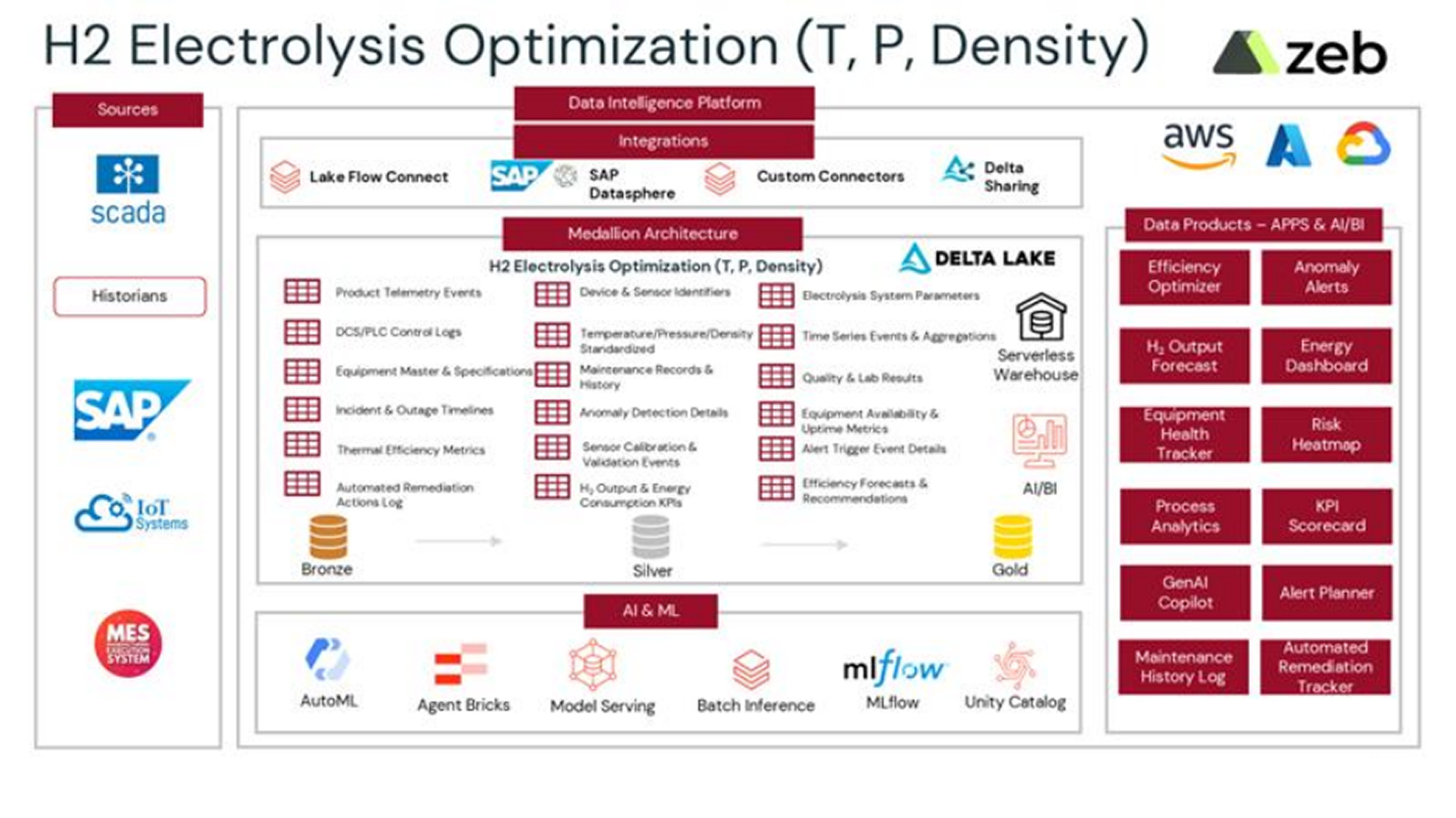
From monitoring to continuous T–P–Density optimization
With unified data in place, zeb deploys machine learning models that learn the relationships between operating conditions and performance outcomes.
Models quantify how temperature, pressure, and current density affect:
- Specific energy consumption in kWh per kilogram of H₂
- Short-term efficiency and purity stability
- Long-term degradation and failure risk
Each stack’s real-time state is evaluated against both safety limits and learned high-efficiency windows. Operators see:
- Whether a stack is inside or outside its recommended efficiency band
- The estimated energy penalty of operating off-optimum
- Early signals of degradation drift
This shifts operations from reactive troubleshooting to proactive performance management.
Strategy sandbox for controlled optimization
Optimization in hydrogen production must balance throughput, efficiency, stack life, and renewable variability.
zeb implements a scenario sandbox that allows engineers to test alternative operating strategies before procedural changes are made.
Users can simulate:
- Alternative temperature bands at partial or full load
- Pressure strategies aligned with storage or pipeline constraints
- Dynamic current density ceilings linked to stack age or energy pricing
Historical data is replayed under these strategies using trained efficiency and degradation models. The system calculates projected hydrogen output, energy consumption, degradation impact, and financial implications.
Baseline versus optimized strategies are compared in clear dashboards, enabling structured, governed operational improvements.
AI-assisted insight for engineering and operations
Beyond dashboards and predictive models, zeb integrates AI-powered conversational analytics grounded in governed process data.
Engineers can ask:
- Why did specific energy increase during the last load cycle?
- Which stacks are operating outside their optimal temperature window?
- What degradation impact is expected if density is increased during peak pricing?
Responses are model-backed, traceable, and confidence-scored. Investigation cycles that previously required manual data extraction are reduced from days to minutes.
Executive portfolio visibility
For hydrogen portfolio leaders, zeb provides consolidated performance analytics across plants and regions.
Executives gain visibility into:
- Fleet-level hydrogen production and active capacity
- Average specific energy consumption
- Asset health and degradation risk
- Energy cost per kilogram versus hydrogen price
- Realized savings from optimization policies
Optimization strategies become governed, version-controlled assets that can be tracked for measurable impact over time.
Measurable impact
Hydrogen producers implementing zeb’s Databricks-based optimization approach can achieve:
- 8 to 12 percent improvement in specific energy efficiency through dynamic T–P–density tuning
- 25 to 40 percent reduction in unplanned downtime via predictive anomaly detection
- Earlier detection of degradation trends
- Shortened investigation cycles from days to hours
Most importantly, electrolysis transitions from static, conservative operation to continuous, data-driven optimization.
Enabling scalable green hydrogen with zeb
As hydrogen capacity expands globally, operational intelligence must scale alongside physical assets. zeb combines deep energy domain expertise with advanced data engineering and AI capabilities to design and implement production-grade Lakehouse architectures on Databricks.
By embedding real-time telemetry, predictive analytics, and governed AI into electrolysis operations, zeb enables hydrogen producers to increase throughput, reduce energy intensity, extend stack life, and strengthen project economics.
Temperature, pressure, and density are no longer fixed settings. They become continuously optimized levers for performance and competitiveness.

 +1 732 737 9188
 sales@zeb.co