

Manufacturing organizations increasingly rely on pre-competitive collaboration to accelerate innovation, reduce R&D costs, and standardize foundational research across the industry. Yet as collaboration expands, engineering teams face a difficult balance: sharing insights without exposing proprietary designs, simulations, or intellectual property. Most R&D environments were never built for this model, leaving data fragmented across PLM systems, CAD tools, simulation platforms, and test infrastructure.
The Databricks App for Pre-Competitive Manufacturing R&D Collaboration provides a secure, AI-assisted environment for consortium-based engineering research. By unifying engineering data and applying governed GenAI capabilities, the app enables manufacturers to collaborate safely, discover higher-value research hypotheses, and measurably improve engineering productivity.
The Challenge: Fragmented R&D data and risky collaboration
Engineering teams generate vast amounts of data across product design, simulation, prototyping, and testing. In large manufacturing ecosystems, this data is scattered across PLM platforms, CAD repositories, IoT sensors on prototypes, simulation engines, ERP project trackers, and collaboration tools. When organizations participate in industry consortia, sharing insights typically requires manual exports, restricted datasets, or delayed reporting to avoid IP exposure.
This fragmentation slows pre-competitive research, limits hypothesis exploration, and makes it difficult to quantify productivity impact. Research cycles often stretch 18–24 months, while collaboration remains cautious rather than data-driven.
A governed Databricks app for consortium R&D
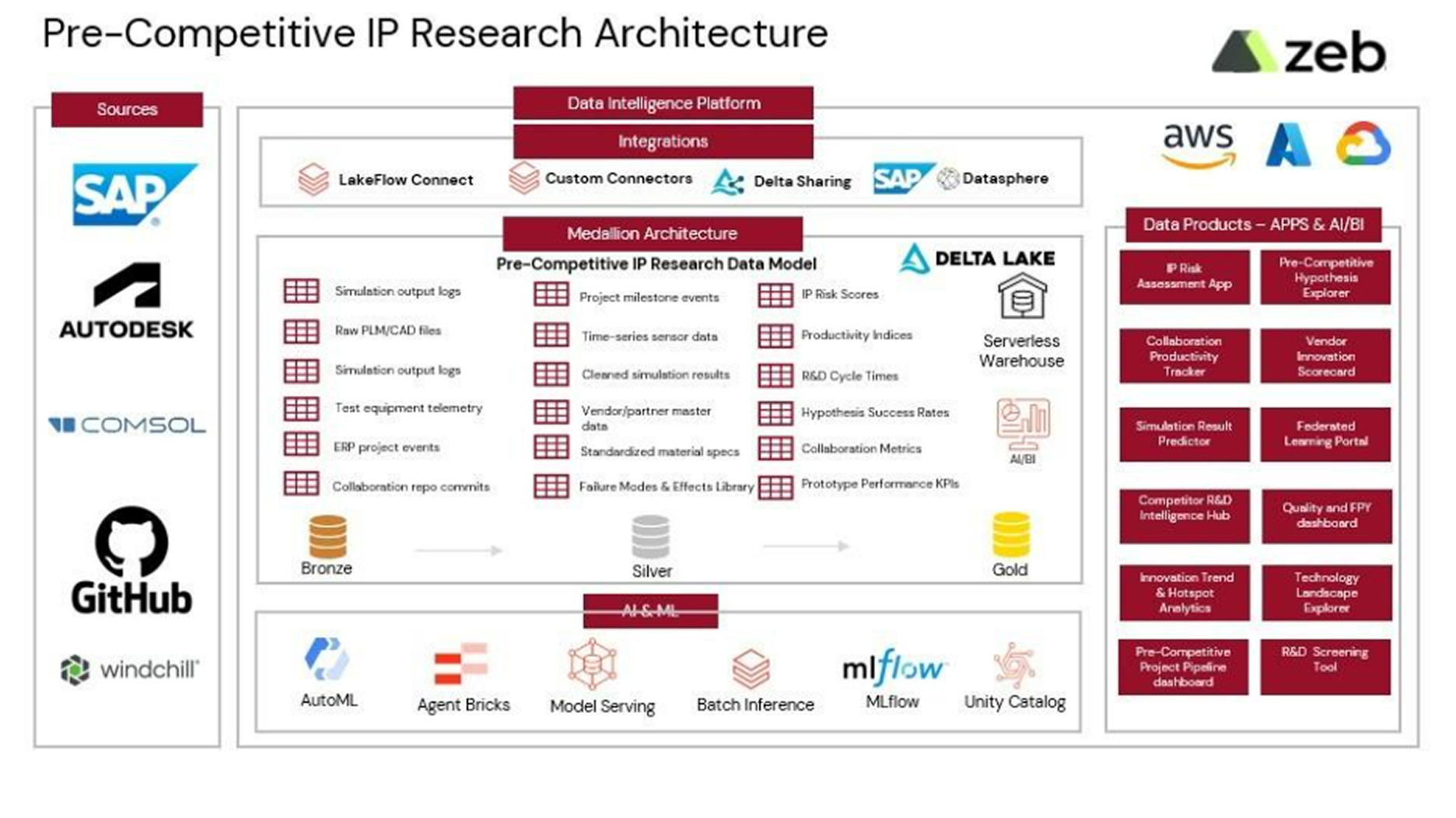
The Databricks App introduces a browser-based workspace where engineering teams can explore consortium insights without copying or moving data. Engineering datasets from multiple partners are ingested into a shared Lakehouse foundation using Delta Lake, ensuring reliable, auditable storage across structured and unstructured sources.
Unity Catalog enforces fine-grained access controls, lineage, and audit trails across all consortium data, allowing partners to collaborate while maintaining strict IP boundaries. Engineers see only the data and derived insights they are entitled to access, with every query and model interaction governed and logged.
AI-Assisted hypothesis discovery and validation
On top of this unified data foundation, ML and GenAI models analyze historical experiments, simulations, and prototype telemetry to generate and score research hypotheses. These models evaluate technical feasibility, potential productivity impact, and IP risk, surfacing the most promising directions for pre-competitive research.
Through Vector Search and Model Serving, engineers can ask natural-language questions such as identifying similar experiments, evaluating material performance patterns, or understanding why a hypothesis is recommended. Responses are grounded in governed data and linked back to source simulations, documents, and test results, ensuring transparency and trust.
Engineer and research lead experience
Lead research engineers interact with the app through focused workflows designed for daily R&D activity. Hypotheses can be explored, validated, or deprioritized with clear explanations and supporting evidence. Collaboration activity across consortium partners is tracked automatically, enabling teams to understand which research areas are advancing and where bottlenecks remain.
For R&D leaders, the app provides real-time visibility into research velocity, collaboration effectiveness, and productivity outcomes. Metrics such as hypothesis validation rates, engineering throughput, and early OEE indicators are continuously updated, replacing static reports and retrospective reviews with live insight.
Measurable impact on R&D and productivity
By unifying engineering data and embedding GenAI into governed workflows, manufacturers reduce reliance on manual analysis and disconnected tools. Pre-competitive research timelines shrink from 18–24 months to under 12 months, while hypothesis discovery rates improve by approximately 40%.
Secure, federated collaboration enables organizations to pursue 50% more joint research initiatives without increasing IP exposure. Engineering teams see 25–35% improvements in throughput, with productivity gains tied directly to validated hypotheses and shared learnings.
The platform scales to petabyte-level engineering datasets and supports thousands of concurrent users, proving that AI-assisted collaboration can operate securely across global manufacturing networks.
How zeb supports secure R&D collaboration
zeb helps manufacturing organizations design and implement Databricks Apps that enable secure, AI-driven collaboration across engineering ecosystems. From integrating PLM, CAD, simulation, and IoT data to operationalizing governed GenAI workflows, zeb supports pre-competitive research initiatives that deliver faster discovery without compromising intellectual property.
Connect with zeb to explore how Databricks Apps can modernize pre-competitive manufacturing R&D collaboration.

 +1 732 737 9188
 sales@zeb.co