

Back and middle office functions underpin critical banking operations such as trade processing, loan servicing, regulatory reporting, and document management. Although banks invest heavily in specialized platforms, these functions often remain fragmented across systems, teams, and data silos. Manual workflows, inconsistent metrics, and delayed visibility continue to constrain efficiency and customer experience.
Back and Middle Office Automation on Databricks addresses these challenges by introducing a governed intelligence layer that unifies data, analytics, and automation across operational processes. This foundation enables banks to move from reactive issue handling to continuously optimized operations.
From fragmented operations to a unified data foundation
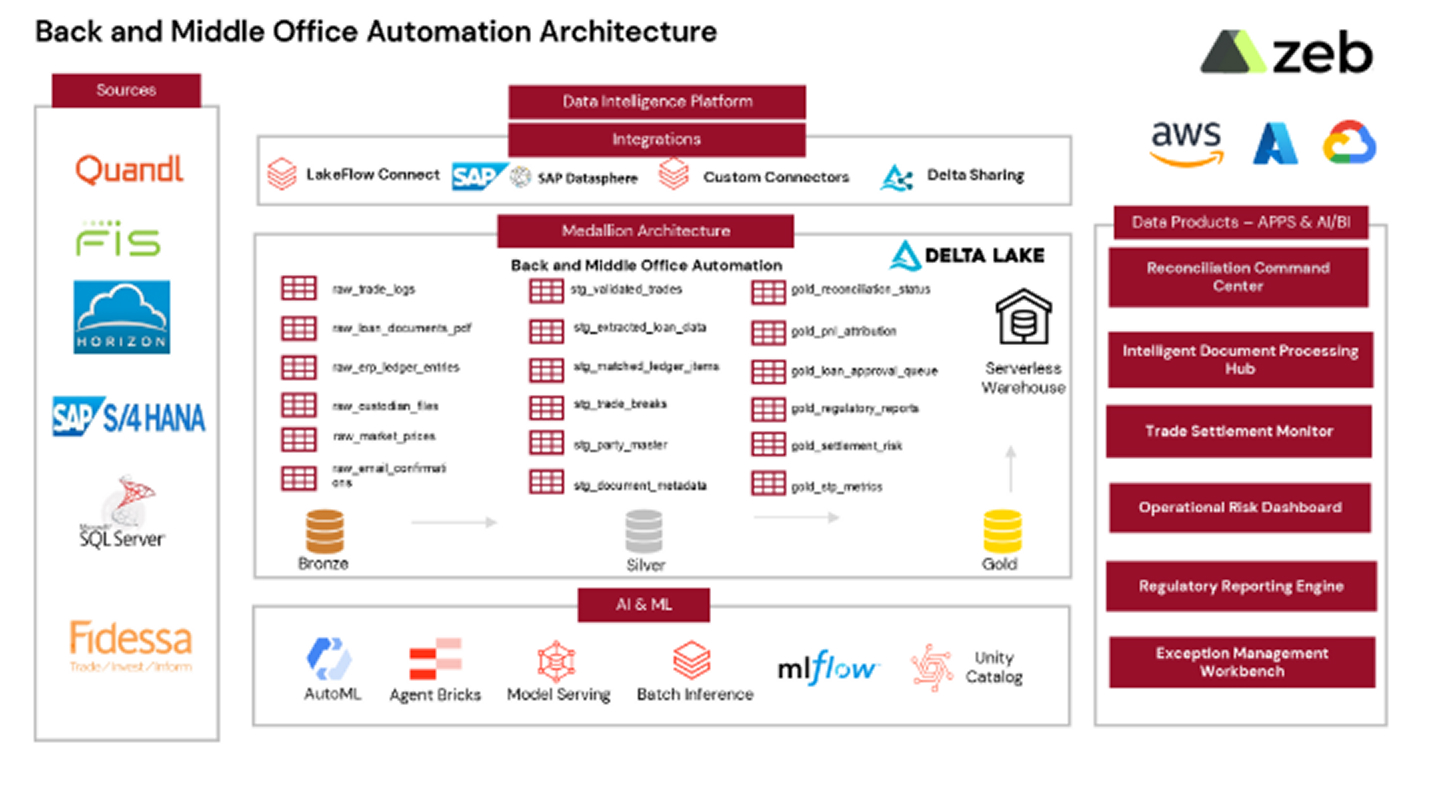
The solution consolidates structured transactions from trading, loan, and ERP systems alongside unstructured documents such as KYC forms, contracts, and emails into a governed lakehouse.
Standardized pipelines create consistent operational datasets covering reconciliation status, document processing, SLA adherence, and risk indicators. Unity Catalog enforces access control, lineage, and auditability across all operational data products.
This unified foundation provides operations and compliance teams with a consistent, real-time view of process state and performance across departments.
Applying intelligence across operational workflows
With unified data in place, analytics and AI models continuously evaluate operational activity to identify inefficiencies and emerging risks.
- Predicts exceptions, processing delays, and SLA breaches
- Detects deviations from expected processing patterns
- Surfaces root causes across transactions, documents, and system events
- Recommends workflow-level actions to reduce delays and rework
- Applies business rules and compliance constraints to ensure consistent handling
This intelligence is embedded directly into operational workflows, enabling improvement without modifying core banking systems.
What operations teams experience
Operations and compliance managers
Teams gain a live view of trade volumes, loan queues, document workflows, exception rates, and SLA adherence. Drill-downs allow managers to isolate bottlenecks by process, department, or time window and intervene early.
Process owners and automation leaders
Historical process replays synchronize transactions, documents, and system events on a shared timeline. AI-assisted diagnostics explain why exceptions occurred and quantify the impact of alternative automation strategies before deployment.
Measuring efficiency, risk, and outcomes
Governed dashboards track straight-through processing rates, exception volumes, processing times, operational cost indicators, and compliance risk. These insights help banks refine automation strategies, demonstrate audit readiness, and link operational efficiency directly to customer experience outcomes.
What makes this approach distinct
Databricks enables back and middle office automation as a governed intelligence layer rather than a replacement for core systems. Key differentiators include:
- Unified operational intelligence across trades, loans, documents, and reporting
- AI-driven insights with transparent and auditable logic
- Embedded analytics without disrupting transactional platforms
- Scalable automation aligned with compliance requirements
- End-to-end data lineage and governance
Start modernizing back and middle office operations
Back and Middle Office Automation on Databricks provides a structured, analytics-driven foundation for improving operational efficiency, reliability, and oversight. By unifying data, embedding intelligence into workflows, and maintaining strong governance, banks can scale automation while retaining control and regulatory alignment.
As a trusted Databricks partner, zeb works with banks to design and deliver data-driven operational platforms that support sustainable efficiency, risk management, and consistent customer experience.

 +1 732 737 9188
 sales@zeb.co