

Manufacturing supply chains are under constant pressure to move faster, operate leaner, and respond to disruptions without delay. Yet for many organizations, order processing remains constrained by fragmented ERP, WMS, supplier, and logistics systems. When order status, inventory availability, and supplier commitments live in disconnected platforms, teams are forced into reactive decision-making, leading to fulfillment delays, inventory imbalances, and rising operational costs.
True improvement in industrial productivity depends on transforming this fragmented operational data into a unified, real-time intelligence layer that supports faster, more confident fulfillment decisions.
Turning fragmented order data into a single source of operational truth
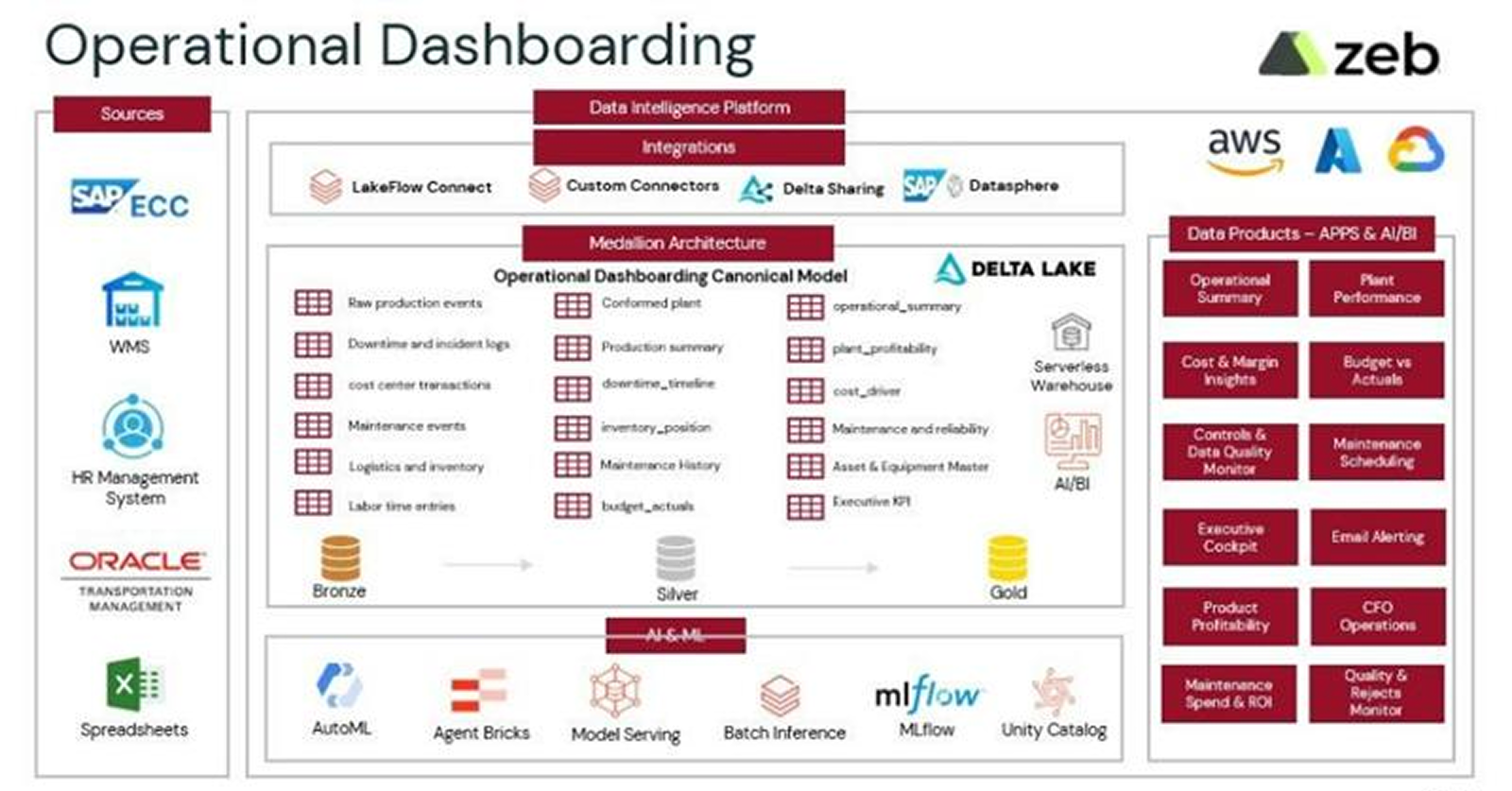
The Order Processing Automation Databricks App for Manufacturing addresses this challenge by unifying real-time order, inventory, supplier, and logistics data into a governed Lakehouse foundation. Built on the Databricks Data Intelligence Platform, the solution ingests streaming data from ERP systems, WMS platforms, supplier feeds, and logistics APIs to create a continuously updated view of the order-to-fulfillment pipeline.
This unified data layer eliminates blind spots across planning, warehouse operations, procurement, and transportation teams. Orders, inventory positions, lead times, and SLA adherence are visible in one place, enabling organizations to move from fragmented monitoring to coordinated execution.
Real-time order pipeline monitoring for faster intervention
With live ingestion and streaming analytics, supply chain analysts can monitor order intake, fulfillment progress, inventory availability, and shipment status as events occur. Real-time health indicators highlight backlog levels, warehouse fulfillment rates, supplier lead-time adherence, and critical stock thresholds.
By surfacing potential bottlenecks early through clear visual signals and data quality indicators teams can intervene before delays cascade downstream. This shift from retrospective reporting to live operational awareness significantly reduces manual tracking effort and shortens response times.
Predictive fulfillment and inventory intelligence
Beyond visibility, the platform applies predictive models to forecast fulfillment performance across warehouses, SKUs, and regions. Interactive dashboards compare historical and predicted fulfillment rates, complete with confidence metrics, allowing teams to assess risk with transparency.
Supplier capacity and inventory risk heatmaps extend this intelligence further by identifying potential stock-outs, supplier delays, and capacity shortfalls across multiple time horizons. Recommended actions such as rerouting orders, expediting shipments, or activating alternate suppliers help teams proactively stabilize fulfillment performance rather than react to disruptions after the fact.
Embedded intelligence for procurement and fulfillment decisions
To support faster decision-making at scale, the solution includes a procurement and fulfillment advisor powered by Databricks GenAI capabilities. Through a conversational interface, users can ask natural-language questions about order risk, supplier performance, inventory levels, and historical fulfillment patterns.
Crucially, every response is grounded in governed data, with lineage visibility and model confidence scores preserved. Proactive alerts notify teams of SLA risks, inventory depletion, or supplier outages, along with recommended actions that align operational execution with procurement strategy and compliance requirements.
Designed for both operational and executive stakeholders
While supply chain analysts benefit from detailed operational dashboards, procurement leaders gain a broader, strategic view. Cross-supplier performance dashboards enable comparisons of lead times, landed costs, quality metrics, and on-time delivery across regions and vendors. This shared intelligence supports data-driven sourcing decisions, strengthens supplier negotiations, and improves alignment between procurement and fulfillment teams.
An executive fulfillment scorecard consolidates end-to-end KPIs including order cycle time, fulfillment rates, expedites, and SLA compliance into a single governed view, allowing leaders to explore performance trends without relying on manual reports.
What sets this approach apart
The Order Processing Automation Databricks App stands out through its tight integration of real-time data, AI-driven insights, and enterprise governance:
- Unified order-to-delivery data across ERP, WMS, suppliers, and logistics systems
- Role-tailored dashboards designed for operational and executive decision-making
- AI-driven exception management with transparent lineage and auditability
- Automated workflows that reduce manual effort while preserving compliance controls
By combining streaming analytics, predictive models, and governed GenAI capabilities, the platform transforms order processing from a reactive function into a proactive, intelligence-driven operation.
Measurable outcomes across fulfillment and procurement
Organizations adopting this approach see tangible improvements across their supply chain operations:
- Manual order processing effort reduced by 60–70%, compressing cycle times from days to hours
- On-time delivery performance improved by 25–35% through predictive routing and capacity optimization
- Excess inventory reduced by 20–30%, with improved inventory turns of 15–20%
- Procurement cost savings of 8–12% driven by better supplier visibility and sourcing decisions
- Stronger SLA compliance supported by unified audit trails and real-time supplier performance tracking
Building intelligent order processing with zeb
Modern manufacturing demands supply chains that are resilient, transparent, and responsive. By leveraging the Databricks Data Intelligence Platform, organizations can unify operational data, automate workflows, and embed intelligence directly into order and procurement processes.
As a trusted Databricks partner, zeb helps manufacturers design and implement scalable, governed order processing solutions that improve fulfillment performance, reduce operational friction, and support long-term productivity gains.
Talk to zeb to modernize your order-to-fulfillment operations with real-time intelligence and AI-driven automation.

 +1 732 737 9188
 sales@zeb.co