

Energy operators managing drilling and mining operations operate in environments where performance variability directly impacts cost, safety, and project timelines.
In upstream drilling, horizontal wells frequently encounter drillstring vibrations, stuck-pipe incidents, and inconsistent rate of penetration (ROP). These issues increase non-productive time (NPT), damage equipment, and extend well delivery schedules.
In mining, drill-and-blast patterns can produce uneven fragmentation and wall instability. The consequences appear downstream, lower shovel efficiency, crusher constraints, and higher cost per tonne.
Although both operations generate vast volumes of telemetry, design, and performance data, this information often resides in disconnected systems. As a result, lessons from high-performing wells or successful blast patterns are rarely applied consistently across assets. Decision-making remains reactive rather than predictive.
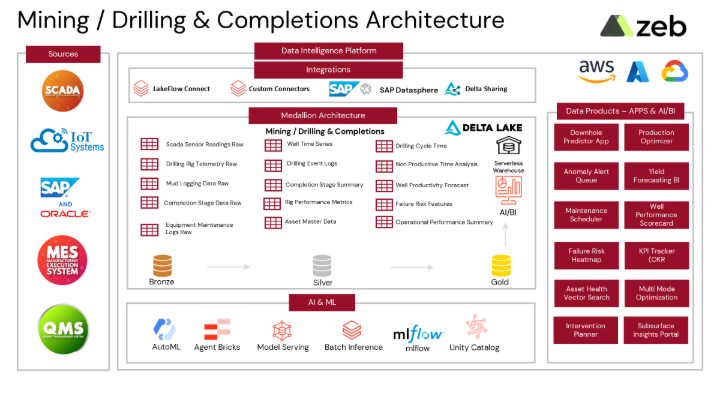
To address this challenge, zeb designed the Drilling & Mining Optimization App on Databricks; a unified intelligence layer that connects drilling and mining workflows, enabling continuous operational improvement.
Establishing a single source of operational insight
The first step was to eliminate fragmentation.
Operational data from rigs and mining drills including telemetry, drilling parameters, equipment health indicators, blast designs, and downstream performance metrics were consolidated into a governed Lakehouse environment.
By standardizing data across wells, pits, formations, and campaigns, teams gained a consistent view of performance. This foundation allowed cross-site comparisons, offset benchmarking, and enterprise-wide analytics that were previously difficult to achieve.
Instead of analyzing wells or blasts in isolation, engineers could now evaluate performance within a broader operational context.
Moving from reactive response to predictive control
With unified data in place, the focus shifted to proactive optimization.
For drilling operations, models were developed to identify early indicators of dysfunction, including stick-slip, whirl, axial shocks, and stuck-pipe risk. Engineers receive risk scores and recommended operating parameter ranges based on historical high-performing wells in similar formations.
This enables crews to remain within safe and efficient operating envelopes while maintaining ROP targets.
In mining operations, analytics link drill execution quality and blast design parameters to actual fragmentation results and downstream productivity metrics. Variations in hole depth, spacing, or burden can be identified before charging, reducing the likelihood of suboptimal blast outcomes.
By connecting design intent, execution quality, and actual results, the system establishes a closed-loop learning cycle.
Embedding continuous learning across operations
A key differentiator of the solution is its ability to convert historical performance into actionable guidance.
Completed well sections and blast outcomes feed back into the system, refining recommended parameter envelopes and design templates. High-performing combinations of BHAs, drilling parameters, and blast patterns are captured as structured playbooks.
This institutionalizes best practices across rigs and pits, reducing dependence on individual experience and accelerating knowledge transfer.
Over time, optimization becomes systematic rather than anecdotal.
Enhancing leadership visibility and strategic planning
Beyond field-level improvements, the application delivers portfolio-level transparency.
Operations leadership gains unified scorecards covering:
- Drilling days versus plan
- NPT trends by cause
- Tool reliability and equipment utilization
- Blast quality indices
- Downstream productivity indicators
This enables leadership to quantify the impact of optimization initiatives, evaluate performance consistency across regions, and support more informed capital and scheduling decisions.
Advanced scheduling algorithms and production forecasting models further enhance planning accuracy. By combining historical performance with real-time inputs, operators can improve rig utilization, reduce scheduling conflicts, and strengthen forecast reliability.
What zeb delivered
zeb designed and implemented the application with a focus on operational practicality and measurable outcomes.
The engagement included:
- Advanced rig scheduling optimization
- Production forecasting models aligned with well characteristics and historical curves
- AI-assisted risk scenario analysis to reduce unplanned downtime
- Drilling performance models integrating operational and ESG considerations
- Unified dashboards tailored to drilling engineers, mining supervisors, and executive leadership
The objective was not to replace existing control systems, but to strengthen decision-making with governed, enterprise-scale data intelligence.
Business impact
Organizations adopting this unified optimization approach have realized measurable improvements:
- Reduction in non-productive time
- Improved drilling rate consistency
- Lower equipment failure rates
- Enhanced blast quality and downstream throughput
- Reduced investigation time for operational issues
- Stronger alignment between planning models and field execution
By integrating drilling and mining performance into a continuous optimization framework, operators reduce variability, improve asset productivity, and strengthen operational resilience.
Enabling intelligent fossil-energy operations
Drilling and mining remain foundational to fossil-energy value chains. As operational complexity increases, efficiency and risk management become critical differentiators.
The Drilling & Mining Optimization App demonstrates how unified data intelligence can transform fragmented reporting into coordinated, predictive decision-making, supporting safer operations, improved throughput, and sustained cost efficiency.
zeb partners with energy organizations to design and deploy Databricks-powered applications that connect operational data, advanced analytics, and AI into a cohesive, governed framework built for enterprise scale.

 +1 732 737 9188
 sales@zeb.co