

Manufacturers today operate under relentless pressure to increase throughput, control operational costs, and accelerate new product introduction, often while working with aging production systems and fragmented data. Isolated MES, ERP, SCADA, and machine-level controls limit visibility into true bottlenecks, delay root-cause analysis, and force teams into reactive firefighting. The result is unplanned downtime, inconsistent OEE, and missed opportunities for continuous improvement.
The Databricks App for Production Performance Optimization transforms how manufacturers monitor, analyze, and optimize production operations. Built on the Databricks Data Intelligence Platform, it unifies real-time IoT sensor streams, MES events, ERP schedules, and quality data into a governed Lakehouse applying AI, predictive analytics, and conversational intelligence to improve OEE, reduce downtime, and accelerate decision-making across plant operations and engineering teams.
Creating a unified foundation for production intelligence
At the core of the solution is a manufacturing Lakehouse that consolidates operational data previously locked in silos. Streaming IoT telemetry, machine events, production logs, maintenance records, and enterprise schedules land in Bronze Delta Lake tables, preserving raw signals with ACID guarantees and time travel for traceability.
In the Silver layer, data is enriched by joining sensor telemetry with equipment specifications, maintenance history, shift calendars, and product context. Curated Gold datasets then materialize trusted production metrics of OEE, throughput, utilization, defect rates, and predictive health scores, ready for dashboards, forecasting models, and AI-driven workflows.
With Unity Catalog enforcing governance, lineage, and fine-grained access control, teams gain real-time insights without compromising auditability or compliance with standards such as ISO 9001.
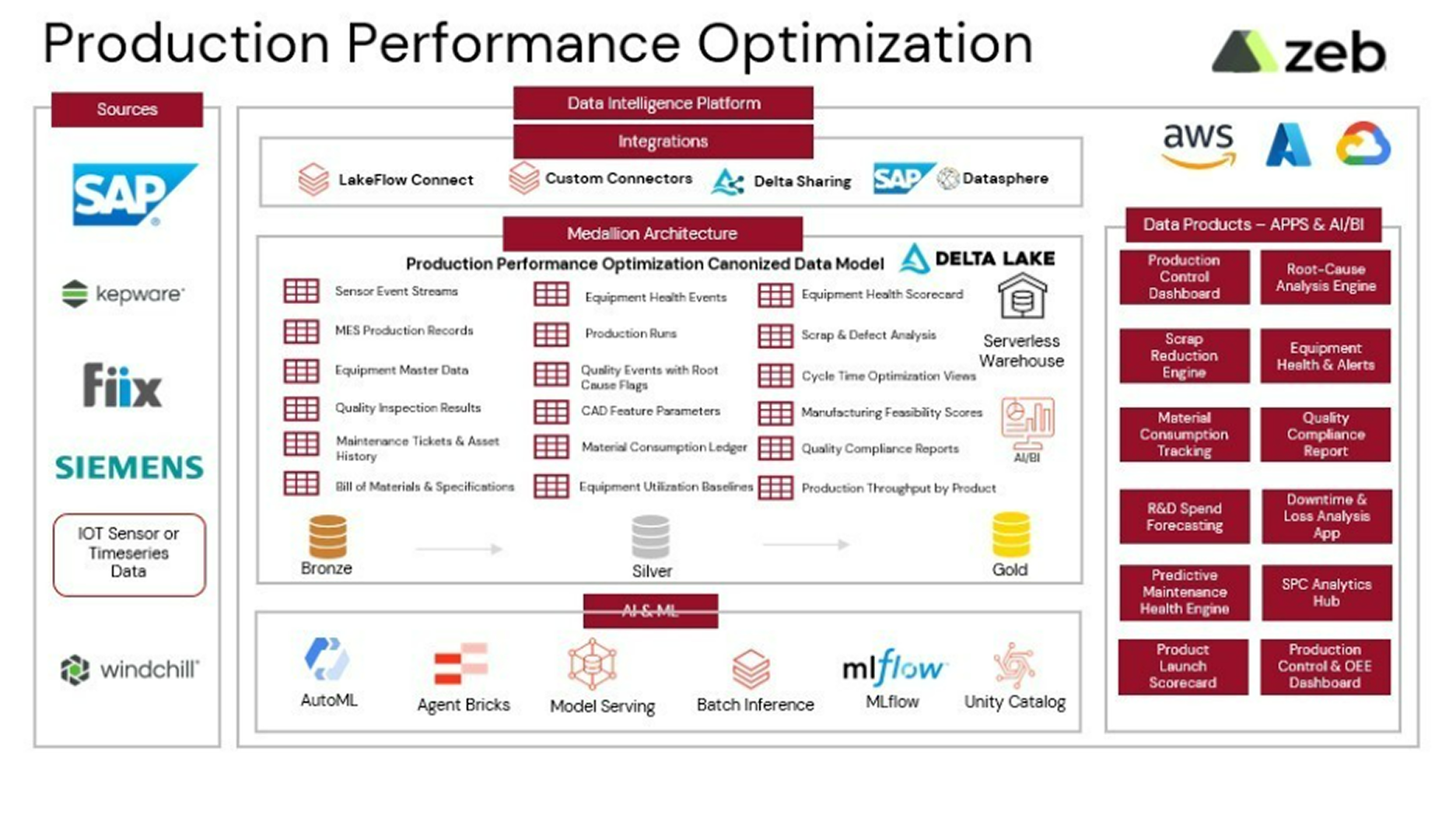
Real-time visibility into production lines and bottlenecks
Plant Operations Managers gain a live view of production health across lines and machines. Streaming dashboards surface real-time sensor readings, MES events, and schedule adherence with data quality indicators and ingestion status per asset.
OEE metrics; availability, performance, and quality are continuously calculated and visualized using intuitive thresholds. Active bottlenecks are highlighted in real time, showing their direct impact on throughput and utilization versus targets. This enables supervisors and operators to identify constraints as they emerge, rather than after production targets are missed.
Predictive maintenance and proactive bottleneck resolution
Beyond monitoring, the platform applies ML-driven intelligence to anticipate issues before they disrupt production. Predictive maintenance models forecast equipment failure probabilities 7–14 days in advance, combining historical sensor trends, maintenance actions, and operating conditions.
Interactive dashboards allow teams to:
- Explore anomaly predictions with confidence intervals
- Drill into machine-level health indicators such as vibration, temperature, and load
- Assess bottleneck impact across shifts and product lines
- Simulate corrective actions and maintenance scheduling
By connecting predictive insights directly to operational context, manufacturers shift from reactive downtime response to planned, risk-aware intervention.
Conversational production intelligence with AI advisors
The Production Performance Advisor, powered by Databricks AI/Genie, enables teams to interact with production data using natural language. Operations and engineering users can ask questions such as:
- “What is the predicted failure risk for Machine X tomorrow?”
- “Which bottlenecks affected throughput last quarter?”
- “Show similar production patterns from previous ramp-ups.”
The assistant returns governed, auditable answers with clear data lineage and model confidence—while proactively surfacing alerts for OEE violations, anomalies, or schedule deviations along with recommended actions.
Supporting engineering and new product introduction decisions
For Engineering and R&D leaders, the platform extends beyond day-to-day operations. Crossline and cross-facility dashboards compare OEE, cycle times, and defect rates to support New Product Introduction (NPI) decisions.
By overlaying ramp-up data against established benchmarks, teams can quickly identify process gaps, optimize line configurations, and reduce rework, shortening time-to-market while maintaining production stability.
What sets this solution apart
The Databricks App for Production Performance Optimization delivers more than visibility—it operationalizes intelligence. Key differentiators include:
- A unified, governed Lakehouse spanning IoT, MES, ERP, and quality systems
- Real-time analytics with ACID guarantees and full data lineage
- ML-driven predictive maintenance and bottleneck forecasting
- Conversational insights through AI/Genie for faster root-cause analysis
- Scalable, multi-facility production intelligence without data silos
Measurable outcomes across manufacturing operations
Organizations adopting this approach have achieved tangible improvements:
- 10–15% improvement in Overall Equipment Effectiveness (OEE) through real-time bottleneck visibility
- 30–40% reduction in unplanned downtime via predictive maintenance forecasting
- 5–15% throughput increase without additional capital investment
- 50% faster operational decision-making, reducing issue resolution from hours to minutes
- Accelerated NPI cycles, cutting rework by 20–35% and shortening launches by months
From reactive operations to continuous production optimization
By converging unified data intelligence, predictive AI, and conversational analytics, the Databricks Production Performance Optimization App turns manufacturing data into a real-time decision engine. Plant managers, engineers, and operations leaders gain the clarity to act early, optimize continuously, and scale production excellence across facilities.
As a Databricks partner, zeb helps manufacturers modernize production intelligence, delivering resilient operations, higher OEE, and sustained competitive advantage through governed, AI-powered manufacturing analytics.

 +1 732 737 9188
 sales@zeb.co