

Production organizations operate in an environment where margins are tightening, asset reliability is under pressure, and sustainability commitments are no longer optional. Equipment must run at higher utilization levels. Maintenance windows must be predictable. Production costs must be transparent at the batch level. And every operational decision must balance throughput, quality, and ESG performance.
Yet most production environments remain fragmented at the data layer.
SCADA systems stream telemetry. MES tracks batches. ERP holds costing data. Maintenance platforms log work orders. Engineering systems store equipment specifications. These systems rarely operate as a unified intelligence layer. The result is siloed optimization, reactive troubleshooting, and limited visibility into how equipment utilization, load planning, and pricing decisions affect overall profitability.
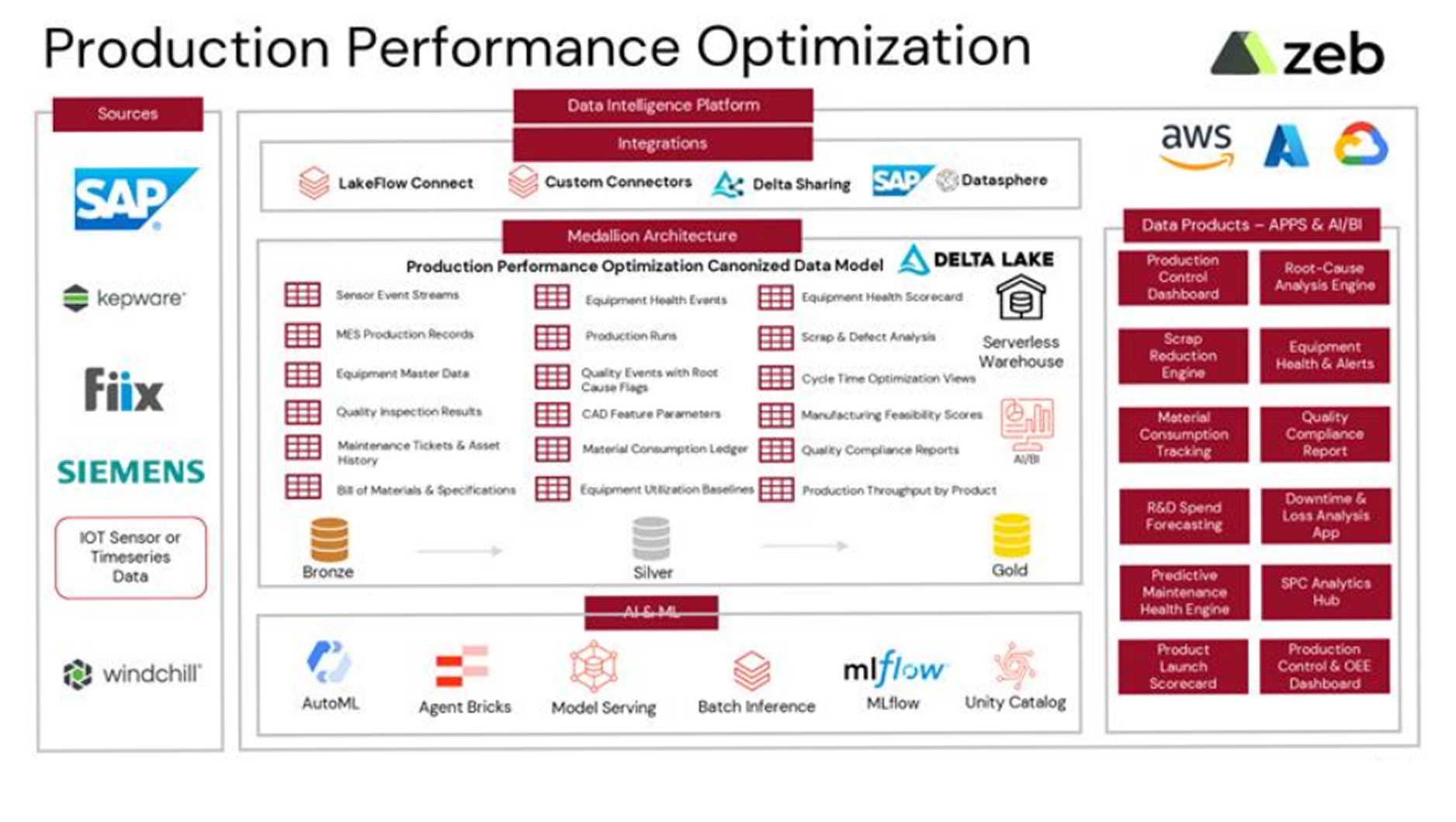
The Databricks App for Production Optimization and Equipment Performance Management transforms production operations into a unified, AI-driven decision engine. Built on the Databricks Data Intelligence Platform, it converges equipment telemetry, production scheduling data, maintenance records, costing information, and ESG metrics into a governed Lakehouse architecture. Advanced analytics, predictive models, and conversational AI then convert this unified data foundation into real-time optimization and financial insight.
Creating a unified production intelligence foundation
At the core of the solution is a production-grade Lakehouse architecture that integrates operational and enterprise systems into a single governed source of truth.
Streaming signals from SCADA systems, equipment sensors, and IoT gateways land in Bronze Delta tables alongside transactional data from MES, ERP, and PLM platforms. Using Delta Live Tables, these feeds are standardized into Silver datasets that align timestamps, asset hierarchies, work centers, and production batches.
Curated Gold datasets expose certified KPIs including:
- Equipment utilization and availability
- Throughput by line and work center
- Mean time between failure and maintenance readiness
- Batch-level cost per unit
- Energy consumption and carbon intensity
- Margin contribution by product line
Unity Catalog enforces governance, lineage, and role-based access, ensuring production, finance, and executive teams work from consistent and auditable data. Databricks SQL Warehouses power operational dashboards, while MLflow, Feature Store, and Model Serving operationalize predictive models across the production network.
This unified foundation replaces siloed analytics with portfolio-wide visibility.
Advanced load planning and equipment utilization optimization
Production efficiency depends on intelligent load allocation across lines and work centers. Static scheduling and manual planning often fail to account for equipment condition, maintenance risk, and downstream bottlenecks.
Advanced AI algorithms developed on Databricks analyze historical throughput patterns, maintenance signals, and equipment performance metrics to recommend optimized load distributions. Predictive maintenance models anticipate potential failures 48–72 hours in advance, allowing proactive adjustments to scheduling before disruptions occur.
Interactive dashboards visualize:
- Current production schedules and equipment allocation
- AI-recommended load redistribution scenarios
- Forecasted utilization rates and downtime reduction
- Throughput impact across lines and facilities
By combining predictive maintenance with load planning optimization, organizations increase asset availability while minimizing unplanned downtime and production volatility.
Batch-level pricing prediction and cost transparency
Production cost optimization requires granular visibility into how materials, labor, and equipment utilization translate into batch-level margins.
The application integrates production batch data, material consumption, equipment utilization rates, and overhead allocation into a costing model built on the medallion architecture. Historical production costs are reconciled and validated, and machine learning models predict real-time batch-level pricing under varying operational conditions.
This enables production managers and finance leaders to:
- Identify cost drivers by product line
- Detect variance from planned production budgets
- Model pricing strategies based on equipment and capacity usage
- Align production planning with margin optimization
By linking operational telemetry to financial models, cost transparency becomes continuous rather than retrospective.
AI-assisted scenario planning and cost-saving analytics
Operational changes often involve risk. Adjusting equipment combinations, shifting production loads, or modifying process parameters can affect cost, quality, and reliability.
AI-assisted scenario planning tools allow production teams to simulate alternative configurations before execution. Engineers can model different equipment allocations, maintenance timing, or process adjustments and assess their financial and operational implications.
Dashboards compare:
- Current configuration versus optimized scenario
- Predicted cost savings and throughput impact
- Downtime reduction potential
- Quality and sustainability considerations
This proactive modeling shifts production optimization from reactive adjustments to structured, data-driven decision making.
Carrier sourcing optimization and ESG intelligence
Beyond throughput and cost, production leaders must meet increasingly stringent ESG and sustainability targets.
The platform applies machine learning to evaluate carrier and production-line performance based on throughput, quality metrics, reliability indicators, and carbon footprint. Real-time sensor data is integrated with energy consumption metrics to quantify Scope 1 and Scope 2 emissions across operations.
Portfolio dashboards surface:
- Carbon intensity per production line
- Energy efficiency trends
- Carrier reliability rankings
- Emissions reduction scenarios tied to load allocation
By embedding ESG metrics into production optimization, organizations align operational excellence with sustainability commitments.
Conversational production intelligence with AI advisors
To democratize access to production analytics, the application incorporates Databricks AI/Genie and the Agent Framework within a unified Databricks App interface.
Production Operations Managers can ask:
- “Which equipment is constraining throughput today?”
- “What is the optimal load distribution for this batch?”
- “Which product line is driving cost variance this week?”
The system returns governed, model-backed answers with confidence scores and operational impact estimates. It also proactively surfaces alerts for equipment health degradation, cost overruns, or bottleneck risks, recommending corrective actions such as rescheduling, resource reallocation, or preventive maintenance.
Investigation cycles that once required multiple systems and spreadsheet analysis are reduced from days to minutes.
Portfolio-level financial and strategic optimization
For CFOs and executive leadership, the platform extends beyond operational dashboards.
Fleet-level views aggregate:
- Total capacity utilization and production output
- Margin contribution by product and facility
- Asset-level ROI and capital efficiency
- Investment prioritization scenarios
Strategic portfolio analytics connect operational efficiency with financial performance, enabling informed decisions about capacity expansion, capital investments, and process modernization initiatives.
Measurable impact across production networks
Organizations adopting unified production optimization intelligence can achieve:
- Up to 50% reduction in unplanned downtime through predictive maintenance
- 5–15% increase in daily recovery or throughput via AI-driven optimization
- 8–12% improvement in cost efficiency through dynamic pricing and scenario planning
- Reduced investigation cycles from days to minutes using governed AI analytics
- Enhanced ESG performance through integrated carbon and energy monitoring
By converging operational telemetry, financial modeling, and AI-driven optimization, production teams gain the clarity to act early, optimize continuously, and sustain competitive advantage.
Enabling intelligent production transformation with zeb
As production networks grow more complex and margin pressure intensifies, the ability to unify data and operationalize AI becomes a strategic differentiator.
zeb partners with production and energy organizations to design and implement governed Lakehouse architectures on the Databricks Data Intelligence Platform. From real-time streaming pipelines and predictive maintenance models to advanced load optimization and GenAI-powered advisors, zeb delivers end-to-end transformation across production ecosystems.
By aligning equipment performance, cost intelligence, and sustainability metrics within a single AI-powered foundation, zeb enables organizations to maximize asset utilization, reduce operational risk, and drive resilient, data-driven production excellence.

 +1 732 737 9188
 sales@zeb.co